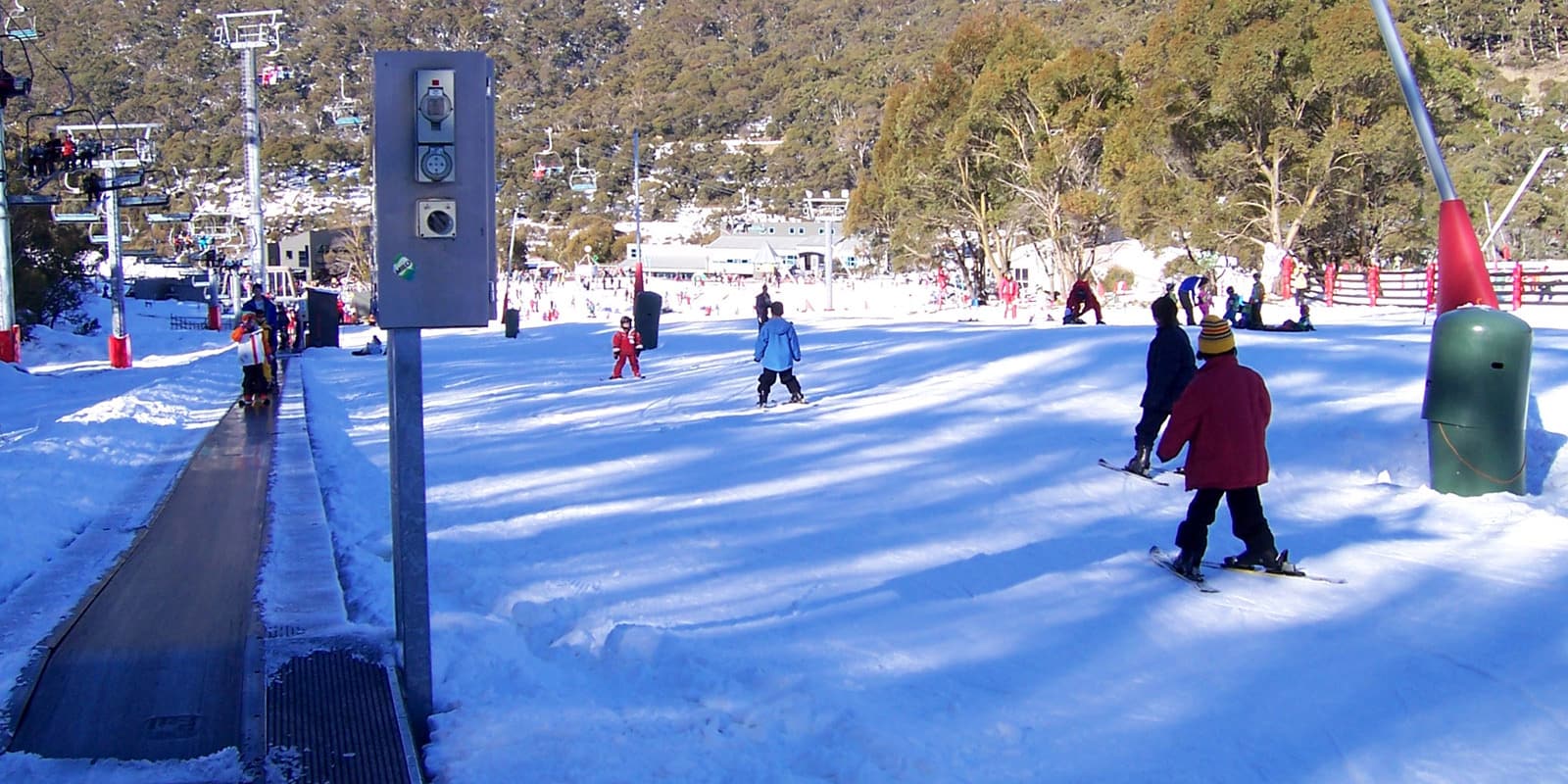
Australia's snow season officially runs from the King's Birthday long weekend in early June to the October long weekend, and in 2026 Victoria's declared snow season ran from 7 June to 4 October. Reliable snow is limited to the Australian Alps in NSW and Victoria, above roughly 1,500 m, and Tasmania's Central Plateau above about 1,000 m. Snow depth usually peaks in August or early September, but the season varies a great deal: 2026 was one of the poorest on record, with several resorts closing in early September.
- Season: King's Birthday long weekend in June to the October long weekend; best snow usually August to early September.
- Resorts: Perisher, Thredbo, Charlotte Pass and Selwyn in NSW; Falls Creek, Mt Hotham, Mt Buller and Mt Baw Baw in Victoria; Ben Lomond and Mt Mawson in Tasmania.
- Cold fronts and lows from the Southern Ocean bring the snow; the Bureau forecasts a snow level, not snow depth.
- Chains: 2WD vehicles in Kosciuszko National Park, and all vehicles at the main Victorian resorts, must carry them in season.
- 2026 peak depth at Spencers Creek was 94.5 cm on 13 August, the third lowest on record.
People overseas are often surprised that Australia has a ski season at all. The Australian Alps cover more ground than you might expect, and in a good year the snowpack near Perisher ends up deeper than a tall person. In a bad year it can be gone by the first week of September. Here is how the season works, where the snow actually falls, and what to check before you pack the car.
When is the snow season in Australia?
The ski season runs from the King's Birthday long weekend in early June to the October long weekend. In 2026, Perisher and Thredbo opened on Saturday 6 June, and Victoria's declared snow season, which sets the dates for chain rules at the alpine resorts, ran from 7 June to 4 October.
Those are the official dates, not a promise of snow. According to the Bureau of Meteorology, permanent snow cover usually starts to settle on the mountains from about mid-June, and the season's peak snow depth is usually reached in August or September, as each new fall builds on the last. By mid-October on the mainland, longer days and warmer weather usually make a marked difference to the snow cover. Snow in autumn is common but usually melts, and the Bureau stresses that early snow is no guide to how good the season will be.
| Period | What to expect |
|---|---|
| Late March to May | Early falls on the high peaks; usually melts within days |
| June long weekend | Season opens; often snowmaking plus natural cover on the upper slopes |
| July | Coldest month; base builds with each cold front |
| August to early September | Usually the deepest snow of the year |
| Late September to October long weekend | Spring skiing, softer snow, season closes |
Where does it snow in Australia?
Reliable snow is confined to the high country. The Bureau puts the usual snow line, where snow cover becomes permanent from mid-June, at about 1,500 m above sea level in south-east NSW and north-east Victoria, and about 1,000 m in central Tasmania. The country's highest peak, Mount Kosciuszko, rises to 2,228 m.
New South Wales: the Snowy Mountains
The NSW resorts sit in Kosciuszko National Park, with Jindabyne as the main base town:
- Perisher, the largest resort, spread across several valleys.
- Thredbo, on the Alpine Way, with its village at the foot of the lifts.
- Charlotte Pass, the highest resort village, reached by over-snow transport in winter. It holds Australia's lowest recorded temperature, −23.0 °C, set in June 1994.
- Selwyn Snow Resort, a smaller, family-oriented area in the north of the park.
Victoria: the High Country
Victoria has more resorts, closer to Melbourne:
- Falls Creek and Mt Hotham, the two big resorts of the Alpine National Park, both high enough to hold snow well.
- Mt Buller, about three hours from Melbourne and the busiest for day trips, with Mt Stirling next door for cross-country skiing.
- Mt Baw Baw, the closest downhill resort to Melbourne, smaller and lower.
- Lake Mountain, mainly for cross-country skiing and tobogganing.
Tasmania
Tasmania's snow falls lower than the mainland's, but its ski fields are small and seasons are short. Ben Lomond, south-east of Launceston, and Mt Mawson in Mount Field National Park are the two club-style fields. The Central Plateau and places like Cradle Mountain see snow most winters, and kunanyi/Mount Wellington above Hobart is often dusted after a cold front.
Snowfall in towns: Canberra, Ballarat, Oberon and Orange
Away from the Alps, snow is a once-or-twice-a-winter event at best, and it rarely lasts. The Bureau notes that cold fronts can drop snow to low levels, even close to the coast, but that low-level snow usually melts within a day or two. It falls most often at night or in the early morning, the coldest part of the day.
The towns that see it most are on high ground. On the Central Tablelands of NSW, Oberon and Orange can wake to snow during strong cold outbreaks, along with the upper Blue Mountains. Canberra's surrounding hills and the Brindabellas get regular falls, while the city itself is usually too low. In Victoria, the Bureau's summary for August 2020 recorded snow at Mount Macedon, the Dandenong Ranges, the Grampians and Ballarat during that month's cold outbreaks.
The polar outbreak of late August 2025 showed how far snow can reach. Forecasters warned of a snow level around 600 m in Victoria and 700 m in NSW, snow near sea level overnight in Tasmania, and possible falls on hills within Canberra, on Hobart's higher suburbs and in the Blue Mountains.
How snow is forecast
The Bureau's snow forecasts are built around the snow level: the height above sea level where rain turns to snow. It does not forecast exact snowfall amounts. Instead its 7-day forecasts give the chance of snow above a certain height, so a forecast of "snow above 1,200 metres" means Thredbo village may get snow while Jindabyne gets cold rain.
A few things help when you read a snow forecast:
- The main snow-makers are cold fronts and low pressure systems that drag Antarctic air north. The colder the air behind the front, the lower the snow level.
- A short-term system that brings 50 to 100 cm of snow counts as heavy snowfall in Australia.
- As a very rough rule, the Bureau says 1 mm of rain is about 1 cm of snow, so 20 mm forecast at a resort above the snow level could mean about 20 cm of fresh snow.
- The Bureau does not issue a seasonal snow outlook. Climate drivers can tilt the odds: a negative Southern Annular Mode tends to push more cold fronts into southern Australia, and El Niño years tend to have lower peak snow depths. Our El Niño and La Niña guide explains these patterns.
For blizzards and dangerous alpine conditions, check the Bureau's warnings before you leave. Above the snowline, wind chill and whiteouts can turn a pleasant day dangerous in an hour.
Driving to the snow: chains and road rules
Both states have strict chain rules during the season, and police do check.
New South Wales. All two-wheel-drive vehicles entering Kosciuszko National Park between the June and October long weekends must carry snow chains. Fit them in the designated chain bays when signs or officers tell you to. The NSW Government recommends driving no faster than 40 km/h with chains on radial tyres and checking their tension after about 200 m. The road from Perisher to Charlotte Pass is usually closed to cars for most of the season.
Victoria. All vehicles, including four-wheel and all-wheel drives, entering Falls Creek, Mt Hotham, Mt Buller, Mt Baw Baw and Mt Stirling must carry chains for the whole declared snow season, which in 2026 was 7 June to 4 October. Only diamond-pattern chains are accepted, and you must fit them when directed. Failing to carry or fit chains brings an on-the-spot fine.
Whichever state you are in, practise fitting chains at home first, fill up before you leave the last big town, and expect black ice on shaded corners early and late in the day.
How did the 2026 snow season go?
Poorly. Snow depth at Spencers Creek, the long-running measuring site near Perisher at 1,830 m, peaked at just 94.5 cm on 13 August, the third lowest peak on record. On 3 September it was down to 31.2 cm, the lowest on record for that time of year. For comparison, Weatherzone noted that the average depth in the first week of September was over 180 cm in the 1950s to 1970s and around 120 cm in the 2020s.
Resorts responded by closing early. Mt Baw Baw and Selwyn stopped their lifts by early September, Charlotte Pass closed on 5 September, and Mt Hotham and Falls Creek ran their last lifts on 6 September, about four weeks ahead of the planned 4 October finish. Thredbo closed on 13 September, roughly three weeks before its planned October long weekend closing, leaving Perisher as the last resort operating.
One bad season doesn't make a trend on its own, but the long-term numbers do. The Bureau reports that peak snow depths have been falling by about 0.7 cm a year at Spencers Creek and 0.6 cm a year at Rocky Valley Dam near Falls Creek, linked to warmer temperatures and less cool-season rain. Seasons still swing widely, and one big storm can make a winter.
Whatever the snow does, pack the sunscreen. Snow reflects UV back up at you, and the Bureau recommends sun protection near snow even when the UV index is low, as our UV index guide explains.
Common questions
What months can you ski in Australia?
The ski season runs from the King's Birthday long weekend in early June to the October long weekend, so roughly June to early October. Early June often relies on snowmaking, and the most reliable natural snow is usually from mid-July to early September, when snow depth at Spencers Creek near Perisher normally peaks. In poor seasons, such as 2026, some resorts close weeks early.
Does Australia get snow every year?
Yes. The high country of NSW, Victoria and Tasmania gets snow every winter, and snow in autumn is common in the Alps. What changes a lot from year to year is how much falls and how long it lasts. The Bureau's State of the Climate reports show maximum snow depth, snow cover and snow days have all declined in the Australian Alps since the late 1950s.
Does it snow in Tasmania?
Yes, Tasmania gets snow every winter on the Central Plateau, kunanyi/Mount Wellington above Hobart, Ben Lomond and Mount Field, and strong cold outbreaks can bring it close to sea level. It can also snow out of season: in early January 2026, parts of Tasmania saw summer snow. Ben Lomond and Mt Mawson are the island's two small ski fields.
Can it snow in Australia in summer?
It can, though it rarely lasts. The Bureau notes snowfall is possible in summer when a strong cold front brings Antarctic air, and in 2026 parts of Tasmania had snow in early January. The Victorian and NSW Alps saw their first falls of 2026 in late March. Summer snow usually melts within a day or two.
Does it snow in Canberra?
Canberra sits at about 580 m, so snow in the city itself is uncommon and usually limited to a light dusting on the surrounding hills during strong cold outbreaks. The Brindabella Ranges to the west see snow far more regularly. In the outbreak of late August 2025, forecasters warned snow could settle on hills within the city.
How accurate is a snow forecast?
Snow forecasts are good a few days out and much less reliable beyond a week. The Bureau says the cold fronts and low pressure systems that bring snow can rarely be predicted more than a week ahead, and it does not issue seasonal snow outlooks. It forecasts the chance of snow above a given height rather than how many centimetres will fall.